
Philosophy
Greek Education Center
Greek Education Center
Philosophy
The Greek Education Center offers courses and experiential seminars on Greek Philosophy, the lifespan of which exceeds one thousand years. With modern teaching methods, those who participate in Greek Philosophy seminars will not only be informed about theories of ancient Greek philosophers. They will learn to think, express themselves and live like Greek philosophers.
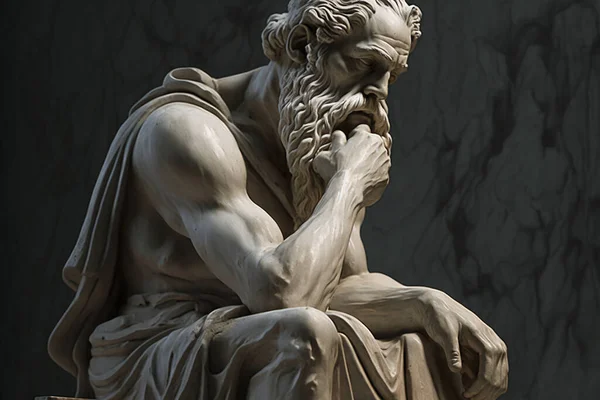
Internationally, philosophical studies begin with studying classical philosophy in the texts of the ancient Greeks. They first thought of their thoughts on the perceptual imprints of the world with philosophical intent. In the classics of the Greek philosophers, the tendency of thought to control speech is testified to represent with meaning and words the cosmic manifestation, the vision, the hearing, and the waves of the senses.
In its first Greek chants, Philosophy was short and measured in its expressions. The Seven Wise Men, the “laconising philosophers”, as Plato mentions in the dialogue Protagoras (343A), left us phrases of two, three and a few more words, which survived in the contemplation of people, valuable aphorisms for various circumstances of life: “μέτρον άριστον” (Cleobulus), “μηδέν άγαν” (Solon), “γνώθι σαυτόν” (Chilon).
Pre-Socratic philosophers, too, went beyond close review of life. They saw themselves as a fragment of the whole. They tried to interpret comprehensively the way the world develops. They saw the momentum and mobility characterising cosmic flow in various elements and wanted the universe to begin from them and unfold in the infinity of its forms. In his “Metaphysics” (983b 6), Aristotle writes: “Of those who philosophised first, most believed that material elements alone are the primary causes of all things. Since that from which all beings originate, and from which they spring in the beginning, and in which they finally end up when they wear out, that from which the essence remains constant, and whose properties only change, this is … the element and this principle of beings, and therefore they believe that neither from nothing is done nor, in the end, it disappears completely…” Thales saw the precious element in water, Heraclitus in fire, Anaximenes in the air, Xenophanes in soil and water, and Anaximander in infinity.
Afterwards, the first sophists from the periphery of the Greek world thought of man as an individual and a social shareholder. They talked about language and religion, art and poetry, ethics and politics. The privileged interlocutor of the Sophists was Socrates. A model of frugality, moral consistency, justice and righteousness, guileless charity, companionship, delicacy and intelligence, peace of mind, tireless self-control and tireless inquiry, Socrates tried, with his presence and speech, to bring people into confrontation with themselves, to make them more honest and effective in thought, better in their association and political life, more rooted in their humanity.
Plato walked in the footsteps of Socrates, as is well known. Like the teacher, the student does not provide solutions to philosophical riddles; Plato cares about the birth and plot of the riddles of Philosophy. That’s why he rarely appears in his dialogues. He is the invisible director and bearer of speech, spoken by foreign lips, the faces of conversations he remembers or constructs.
Classical philosophy takes another turn with Aristotle, a student of Plato. In him, thought evolves robustly, with the certainty of a scientist who follows principles – guides in all the fields that research pushed him: ethics, politics, logic, and physics.
In every era and today, classical Greek philosophy’s texts catalyse the contemplative restoration of man to himself. Reading them presupposes distance from the mechanical way of life and freedom from the consciousness that – by acquiescing – accompanies it. As an exercise on paper, the contemplative turn to an archaic form of perceiving and unravelling reality would bring knowledge into more direct contact with human matter. Ancient Greek and Hellenistic texts reflect the thoughts of people whose individual and more expansive physical existence, their personal, always political, action, and the fatal movements of nature were the self-evident object of their perception and reasoning. Therefore, the ancient classical philosophical texts, objects of inquiry and factual research themselves, are dialectically presented in the modern world, questioning the fact of its development and making it a source of questions.
Philosophy
Thirteen courses, one and a half hours each.
- 1. Thales, Anaximander, Anaximenes
- 2. Heraclitus, Parmenides
- 3. Democritus, Protagoras, Gorgias
- 4. Socrates
- 5. Plato
- 6. Aristotle
- 7. Epicurus
- 8. Zenon
- 9. Diogenes
- 10. Epictetus
- 11. Marcus Aurelius
- 12. Sextus Empiricus
- 13. Plotinus